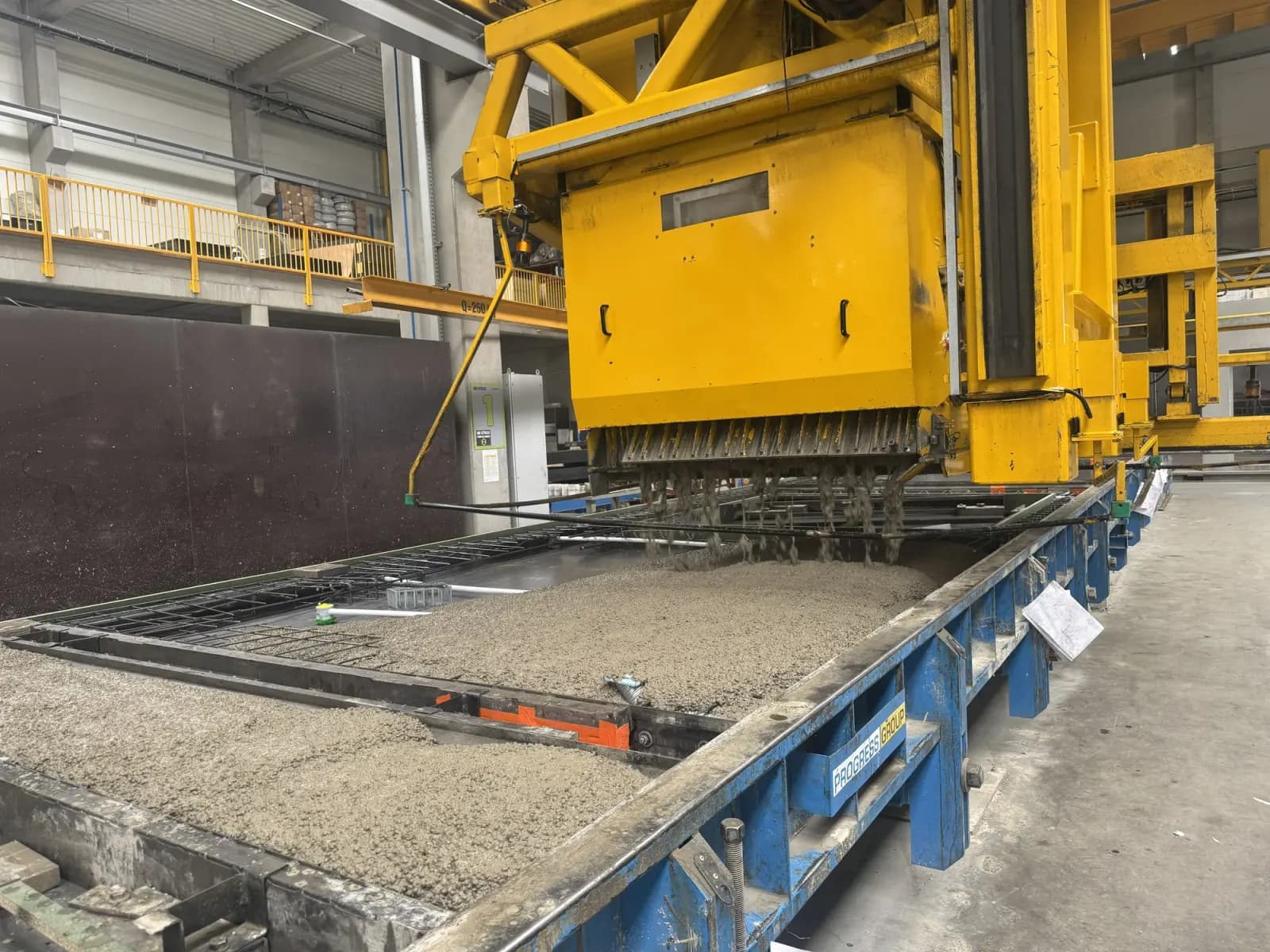
Precast elements made of expanded clay (LECA) concrete
What is expanded clay concrete?
Expanded clay concrete is a lightweight concrete in which natural aggregate is replaced with expanded clay (LECA) — fired clay with a porous structure. The air enclosed in the granules reduces the element's weight and its thermal conductivity, while the sintered shell of each granule retains the strength needed in a load-bearing structure.
In practice, this means a wall that, at the same thickness, weighs noticeably less than its normal-weight concrete counterpart and retains heat better — without giving up load-bearing capacity, non-combustibility or moisture resistance.
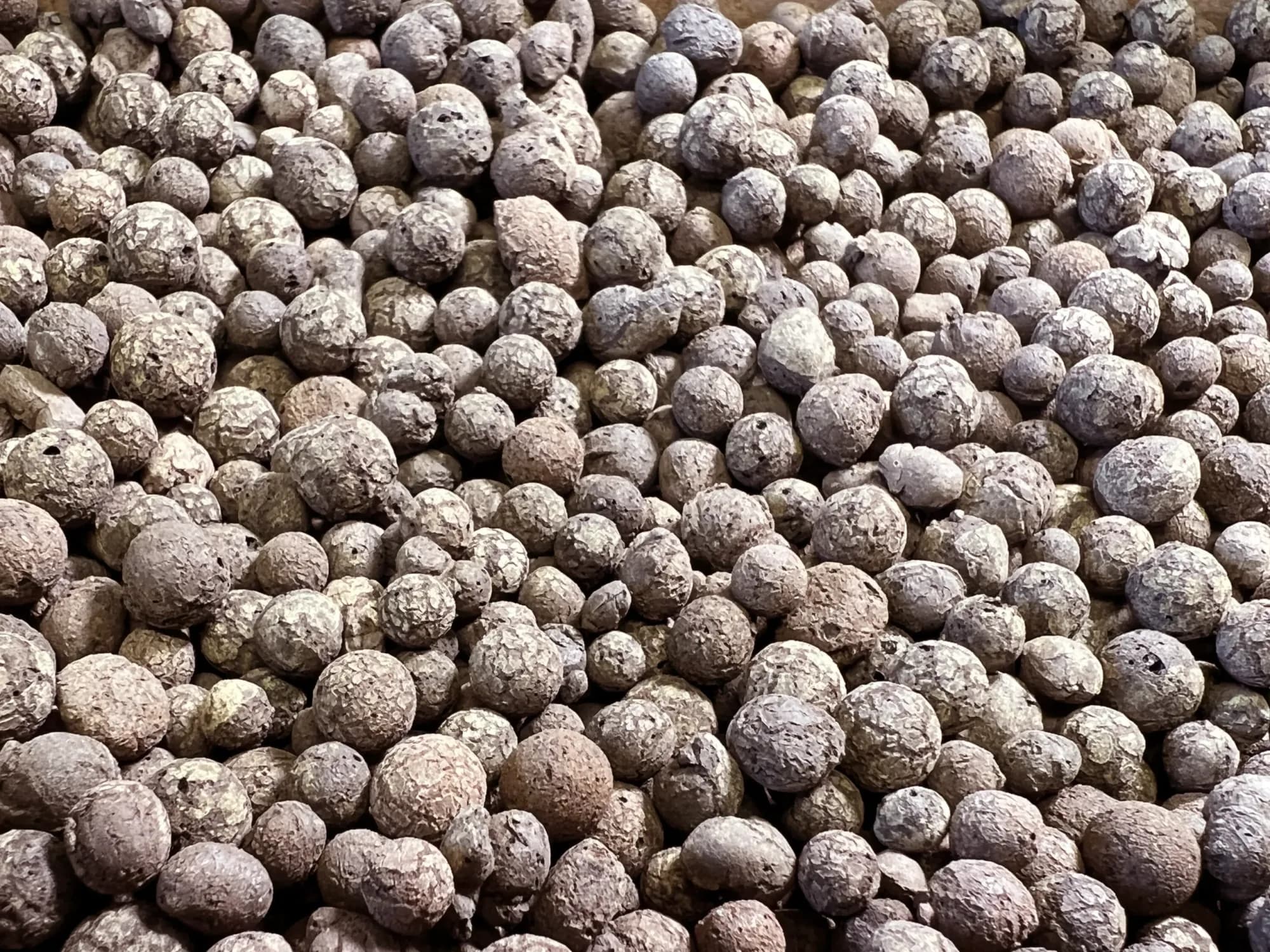
Light yet solid construction
Lower element weight reduces the load on the structure and makes transport and installation easier, while maintaining high strength.
Better energy efficiency
The structure of expanded clay supports the insulation performance of the building envelope, allowing more energy-efficient buildings to be designed.
Durability for years
Resistance to moisture, frost and the weather makes expanded clay concrete a reliable choice in demanding service conditions.
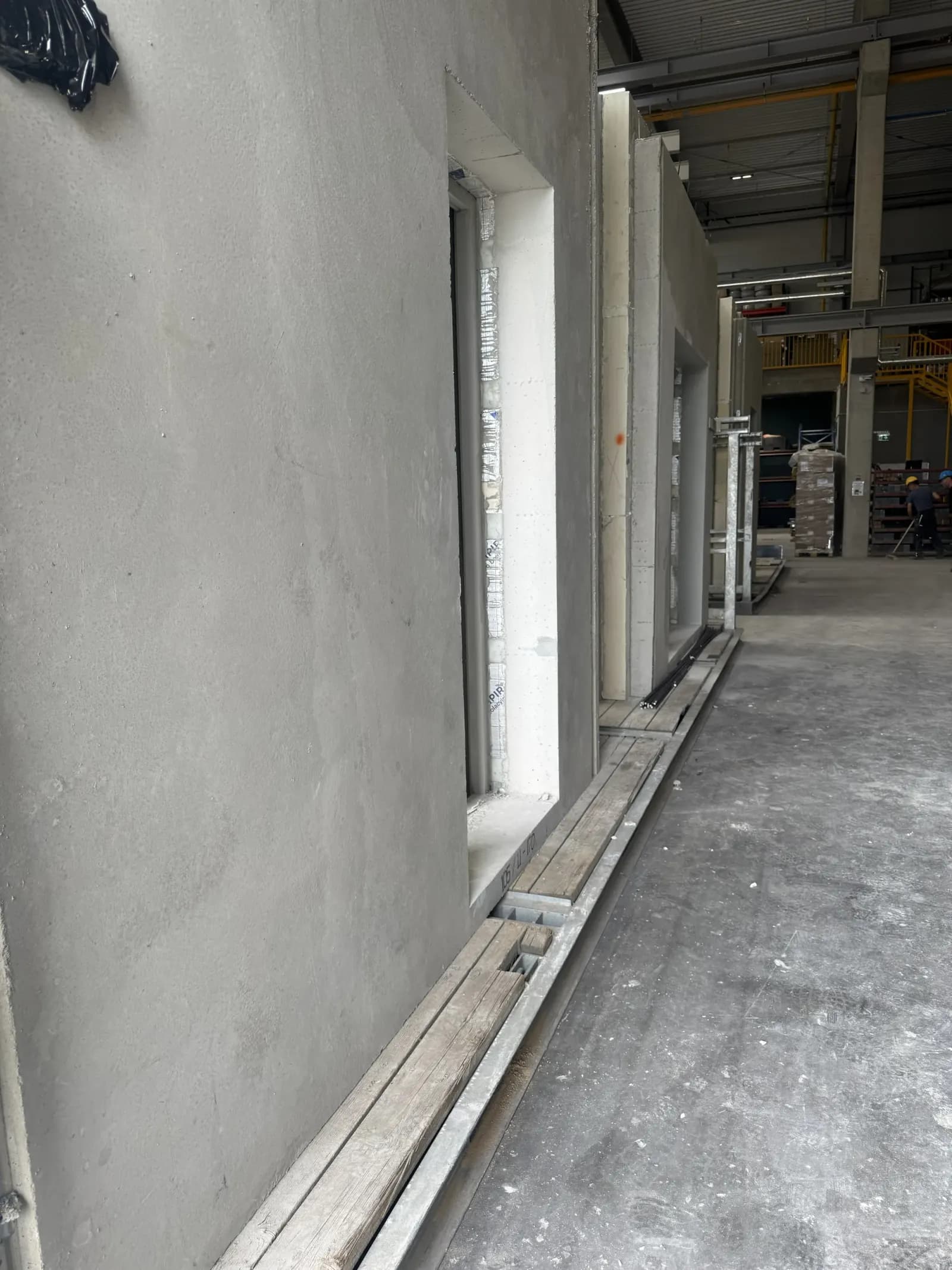
From an accidental discovery to precast production
The history of expanded clay begins in 1913 at Hayde's brickworks in the United States. During a kiln failure, at too high a temperature, a lightweight ceramic aggregate was created by accident. The owner patented it immediately and production began in 1917 — the material was named haydite after him and was used to make lightweight concrete and small building components.
By 1939 haydite plants were already operating in Canada, Sweden, Norway and Denmark. After the war, demand for lightweight aggregate grew so much that factories sprang up around the world, and the material found uses in construction, geotechnics, horticulture and environmental protection. In western countries the name LECA — Lightweight Expanded Clay Aggregate — took hold. In Poland it was first called GLINIEC, after the clay it is made from, and later the name keramzyt was introduced, inspired by the Greek keramos, meaning potter's clay.
Expanded clay concrete itself emerged in response to the need for lighter, more energy-efficient structural solutions. Since the mid-twentieth century the material has been used in residential, industrial and infrastructure construction, combining the durability of concrete with the insulating properties of expanded clay.
Today expanded clay concrete is used in modern precast production, where manufacturing precision and element repeatability allow projects to be delivered faster and more efficiently.
Technical parameters of expanded clay concrete
We produce elements in classes LC12/13, LC16/18 and LC20/22, in thicknesses from 10 to 24 cm. Layered walls achieve fire resistance of R60–R240 and EI30–EI60 with insulation up to 300 mm. All elements are covered by certificate 0761-CPR-1152 issued by IBMB MPA TU Braunschweig, in accordance with EN 14992:2007+A1:2012.
| Concrete class | Density class | λ [W/(m·K)] | Weight of a 10 cm wall | Rw |
|---|---|---|---|---|
| LC12/13 | D1,4 | — | 140 kg/m² | 39,3 dB |
| LC16/18 | D1,6 | 0,9 | 160 kg/m² | 41,5 dB |
| LC20/22 | D2,0 | 1,1 | 180 kg/m² | 43,5 dB |
| C20/25 (normal-weight concrete) | D2,4 | 2,0 | 235 kg/m² | 47,9 dB |
Three types of expanded clay concrete walls
The same material comes in three wall build-ups. The choice depends on how many layers are made in the factory and how many on site.
Solid walls
A single structural slab — for walls separating flats, lift shafts and stabilising walls. Used as an external wall, it needs insulation and render added on site.
- Thicknesses of 10, 12, 15, 18, 20 and 24 cm
- Concrete from class LC12/13 (D1,4)
- Cast-in electrical boxes and conduits, ready-made openings for windows and doors
Two-layer walls
A structural slab with a factory-bonded insulation layer. The facade is built on site, so the architect keeps full freedom in choosing the finish.
- 150 mm structural leaf, insulation up to 300 mm
- Fire resistance R60–R240 and EI30–EI60
- Sound insulation Rw up to 50 dB
Sandwich walls
A complete external wall in a single element: structural leaf, insulation and a concrete facing layer. A ready-made, maintenance-free facade arrives on site.
- Structural leaf min. 15 cm, insulation up to 300 mm
- Concrete class LC20/22 or C20/25 and higher
- A durable external finish straight from the mould
The thermal transmittance depends on the type and thickness of the insulation: for a wall in class LC16/18 it is 0,165 W/(m²·K) with 20 cm of mineral wool and 0,117 W/(m²·K) with 18 cm of resol foam. Both values comfortably meet the Polish WT 2021 requirement for external walls, i.e. a U-value no higher than 0,20 W/(m²·K).
Where does expanded clay concrete perform best?
Expanded clay concrete works wherever a lightweight structure, good insulation and durability matter. See where it is used most often.
Residential construction
Walls and structural elements in houses and multi-family buildings — comfort, stability and better thermal performance.
Precast element production
Repeatable components produced under controlled conditions — fast installation and predictable quality on site.
Industrial facilities
Halls, technical facilities and service buildings — a material that stands up to intensive use and demanding working environments.
Infrastructure and details
Complementary and special elements — wherever durability, dimensional stability and easier logistics matter.
Expanded clay concrete or normal-weight concrete?
Expanded clay concrete is chosen where warmth and weight matter: a 10 cm wall in class LC12/13 weighs 140 kg/m² compared with 235 kg/m² for C20/25 concrete, and thermal conductivity drops from 2,0 to 0,9 W/(m·K). Lower weight means lighter foundations, fewer transport runs and a smaller crane on site.
Normal-weight concrete remains the better choice for the highest loads and where sound insulation is decisive — the same 10 cm wall achieves Rw 47,9 dB versus 39,3 dB for expanded clay concrete. In practice we match the material to the specific wall, often combining both in a single building.
Expanded clay concrete — frequently asked questions
What you should know about the material before deciding on expanded clay concrete walls.
- What is expanded clay concrete?
- It is a lightweight concrete in which natural aggregate is replaced with expanded clay (LECA) — fired clay with a porous structure. The result is a material noticeably lighter than normal-weight concrete, with better thermal insulation, which still provides enough load-bearing capacity for structural walls.
- How does expanded clay concrete differ from ordinary concrete?
- Above all in weight and thermal conductivity. A lighter element means lower loads on the foundations and cheaper transport, while the porous aggregate limits heat transfer. Normal-weight concrete remains better where maximum compressive strength counts — which is why we manufacture with both.
- Is expanded clay concrete warm?
- It has a lower thermal conductivity than normal-weight concrete, but in an external wall it still works together with an insulation layer. The gain is that the structure itself cools the wall less and thermal bridges are easier to eliminate.
- Are expanded clay concrete walls load-bearing?
- Yes. We use it to produce structural walls in single-family and multi-family buildings. The concrete class and reinforcement are selected to match the loads set out in the structural design.
- How does expanded clay concrete perform in fire and against noise?
- It is non-combustible, and its porous structure supports sound insulation. The specific fire resistance classes and acoustic parameters depend on the thickness and build-up of the wall — we state them in the element documentation.
- Can you drill into an expanded clay concrete wall and hang heavy items on it?
- Yes, using fixings designed for porous materials. Service chases, however, are best planned in the design — we form them in the mould, so the finished element does not need to be cut into on site.