ProductsPrecast stairs
Stairs precast reinforced concrete
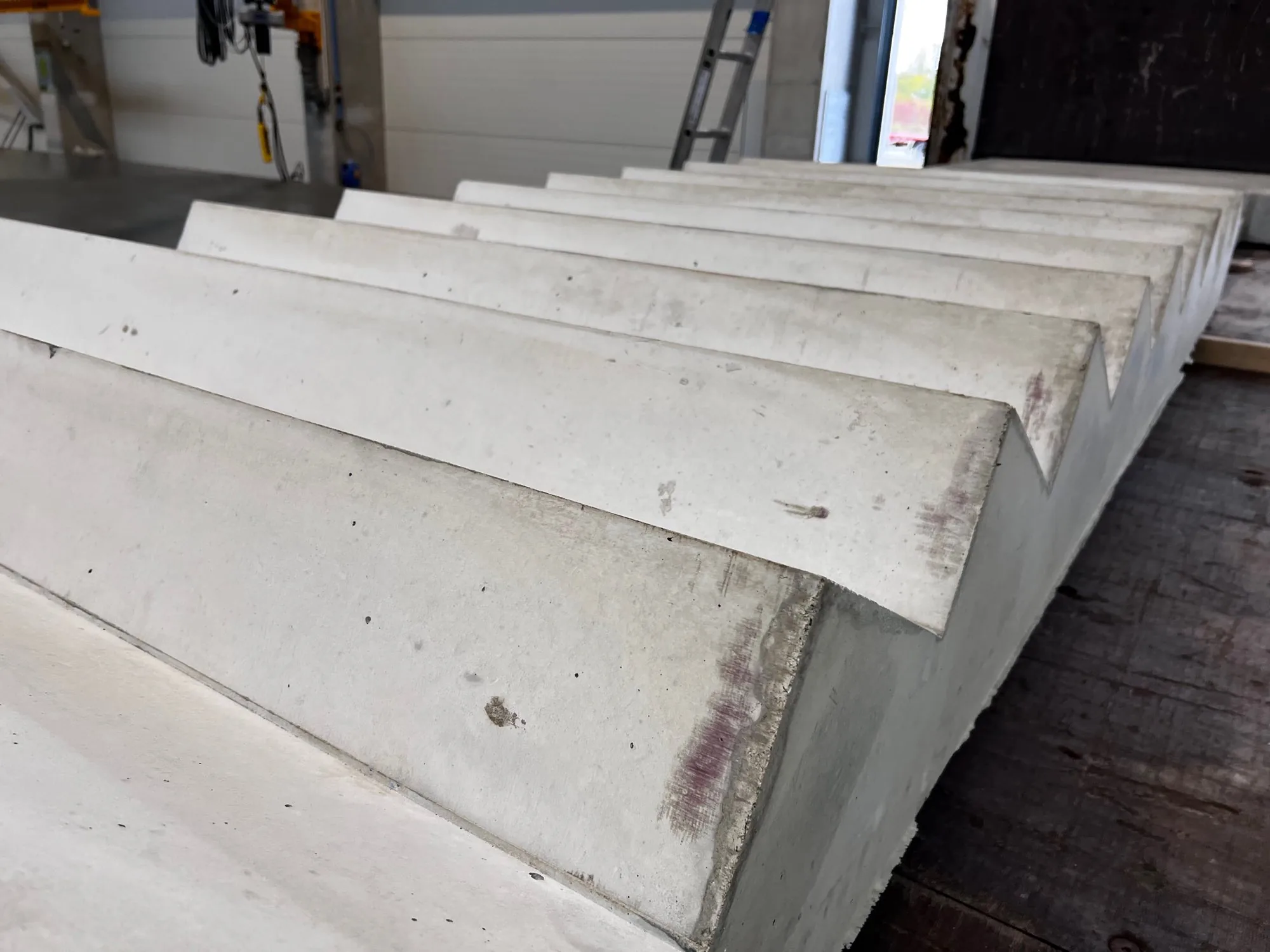
A stair flight ready for installation
As standard we produce precast stairs with smooth, as-struck surfaces in natural concrete grey. To special order we make them with sandblasted surfaces or in anthracite.
Safety in use is improved by sandblasted strips and anti-slip inserts. Edge trims protect the step nosings from damage and further reduce the risk of slipping.
The production method determines which surfaces remain exposed. In the vertical method, one stringer face is smoothed and the remaining surfaces are as-struck from the mould. In the horizontal method, the underside is lightly smoothed.
They are most often searched for as concrete stairs or ready-made concrete stairs. Precast means the flight is produced in a mould rather than cast on site.
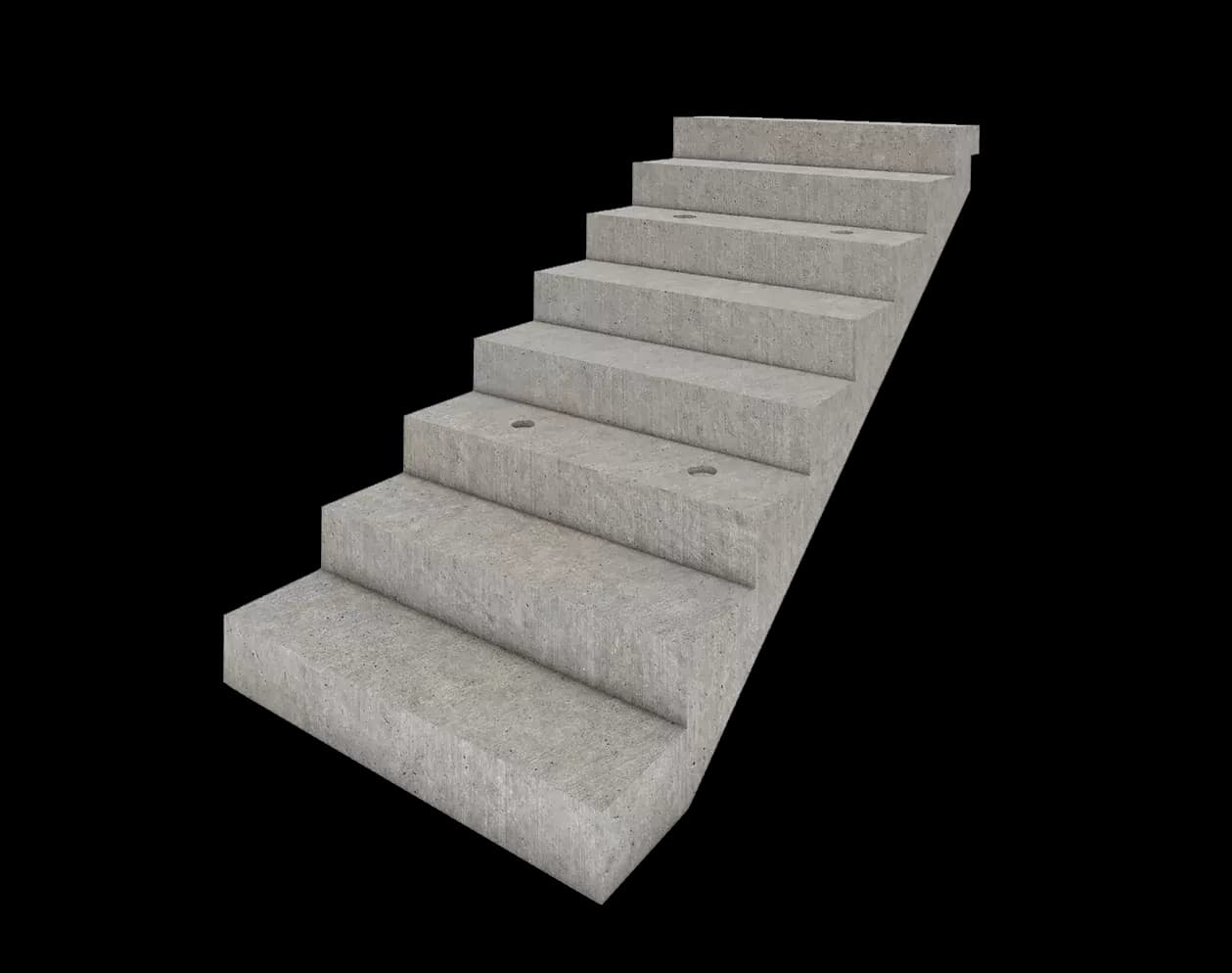
Precast stair parameters
Stair elements are covered by Declaration of Performance 04/24 and produced under Factory Production Control.
DoP 04/24 · Factory Production Control
- Variants
- Single and multi-flight stairs, with or without a landing
- Riser height
- From 15 to 22 cm
- Going (tread length)
- From 21 to 32 cm
- Stair waist thickness
- From 20 to 35 cm
- Flight width
- Up to 160 cm
- Concrete class
- C35/45 or higher
- Standard surface
- Smooth as-struck, natural concrete grey
- Made-to-order variants
- Sandblasted surface, anthracite colour
- Vertical casting: one stringer face smoothed, the remaining surfaces smooth from the mould. Recommended when the steps will be clad on site.
- Horizontal casting: the underside is lightly smoothed.
- Anti-slip inserts and edge trims are factory-fitted on request.
Step finishes
The standard is a smooth, as-struck surface. Additional features improve safety and protect the nosings.
Sandblasted tread surface
Increased roughness across the full width of the tread or in strips.
Anti-slip insert
Factory-fitted, improves grip at the nosing of the step.
Edge trim
Protects the nosing from damage and further reduces the risk of slipping.
Anthracite colour
A special-order variant, available together with a sandblasted surface.
What determines the price of precast elements
Precast elements are not priced from a per-metre price list — every element is designed for a specific project, and the difference between two projects of the same floor area can reach several tens of percent. So instead of a rate, we explain what actually determines the figure in your offer.
We prepare a quote within about a week of receiving complete documentation: dimensioned floor plans, sections, elevations and the site location with a postcode. The offer covers production, transport and installation — each item is priced separately, so you can see where there is room for savings.
- Element repeatability
- The single biggest variable. The same element produced in a series is markedly cheaper than a one-off, because the mould and production set-up are spread across many casts. A design based on a few repeatable types works out cheaper than one with dozens of unique elements.
- Concrete class and reinforcement
- A higher class means more cement; higher loads mean more steel. Sizing for the actual loads, rather than with excess margin, can cut the cost without compromising the structure.
- Surface finish
- A smooth, as-cast surface from the mould is standard. Form-liner textures, acid etching or architectural concrete in category BA2 or BA3 require additional formwork and tighter controls, which shows in the price.
- Factory-fitted features
- Cast-in boxes, conduits, openings and corbels increase the element price but remove the cost of chasing and fixing on site. On larger series this usually works out cheaper than doing the work on site.
- Transport and size
- The price depends on the distance and the number of loads. Elements up to 3,85 × 9,00 m travel on a standard vehicle; larger ones require abnormal-load transport with an escort vehicle and permits, which changes the calculation significantly.
- Timing and season
- Production runs in parallel with the groundworks, so ordering early gives flexibility in the programme. Forced deadlines and next-day deliveries always cost more.
Concrete stairs — questions
The questions investors and contractors ask most often. Yours is not here? Write to us — we'll give you a straight answer.
- How much do precast concrete stairs cost?
- The price depends on the flight geometry, the number of steps, the surface finish and the concrete class. A straight flight for a single-family house costs less than winder or stringer stairs of the same length. We prepare a quote from the plan and section of the staircase — usually within about a week.
- How long does it take to install precast stairs?
- A single flight is set in place in around fifteen minutes; a full staircase in a multi-family building usually takes a day. The stairs arrive finished, so there is no formwork, no reinforcement and no weeks of curing on site.
- Can the stairs be used immediately after installation?
- Yes. The element has its full strength on delivery, so once set and secured it immediately serves as the crew's circulation route — unlike stairs cast in place.
- What surface finishes are possible?
- The standard is a smooth surface from the mould, ready for cladding. Variants for direct use are also available, as well as architectural concrete if the stairs are to remain exposed.
We'll select the right elements for your project
Send us dimensioned floor plans, sections and elevations — we will prepare an element selection, a schedule and a quote. Preparing a quote takes around a week on average.