ProductsTwo-layer walls
Two-layer walls the precast half-sandwich
When to choose a two-layer wall?
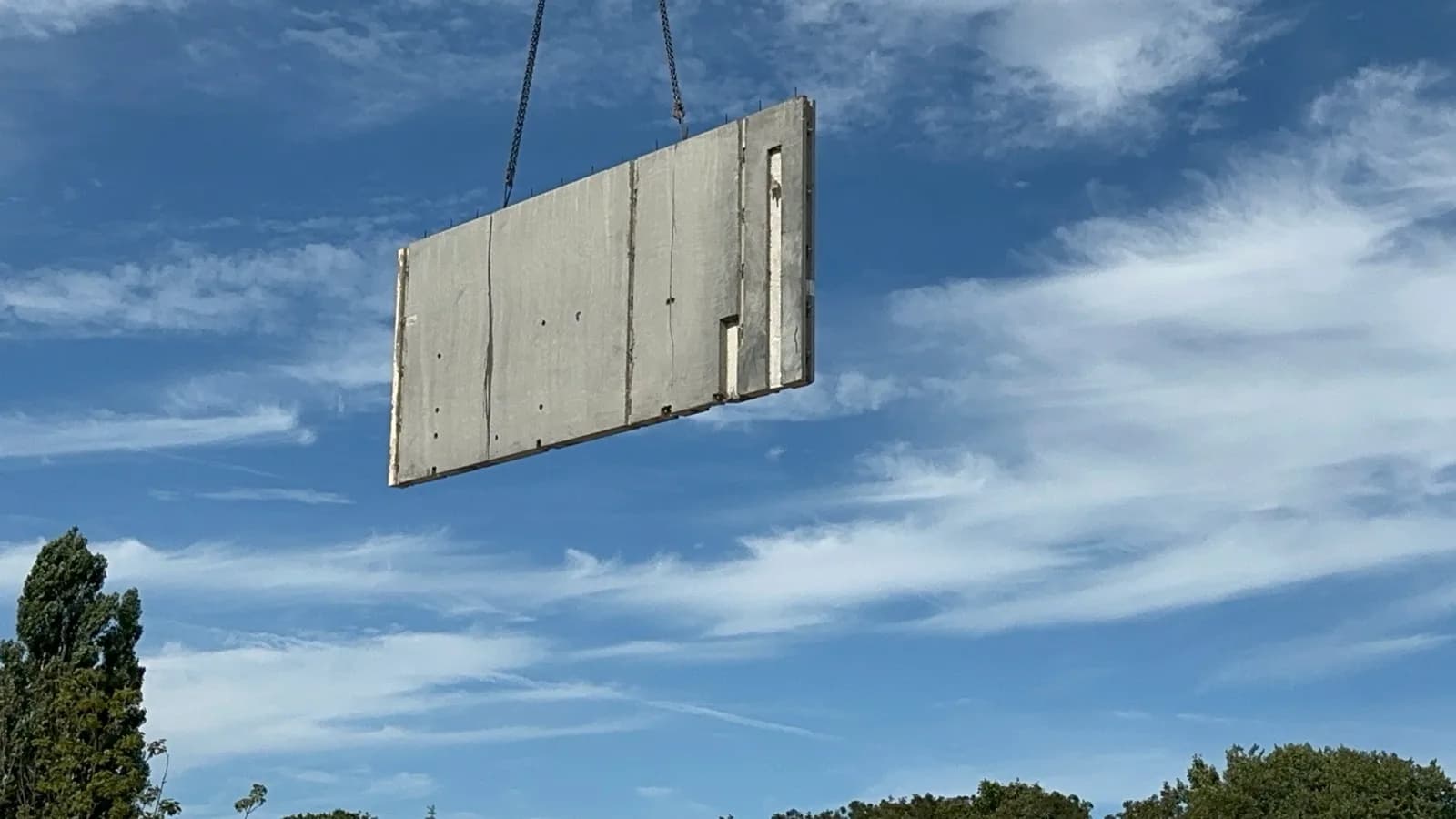
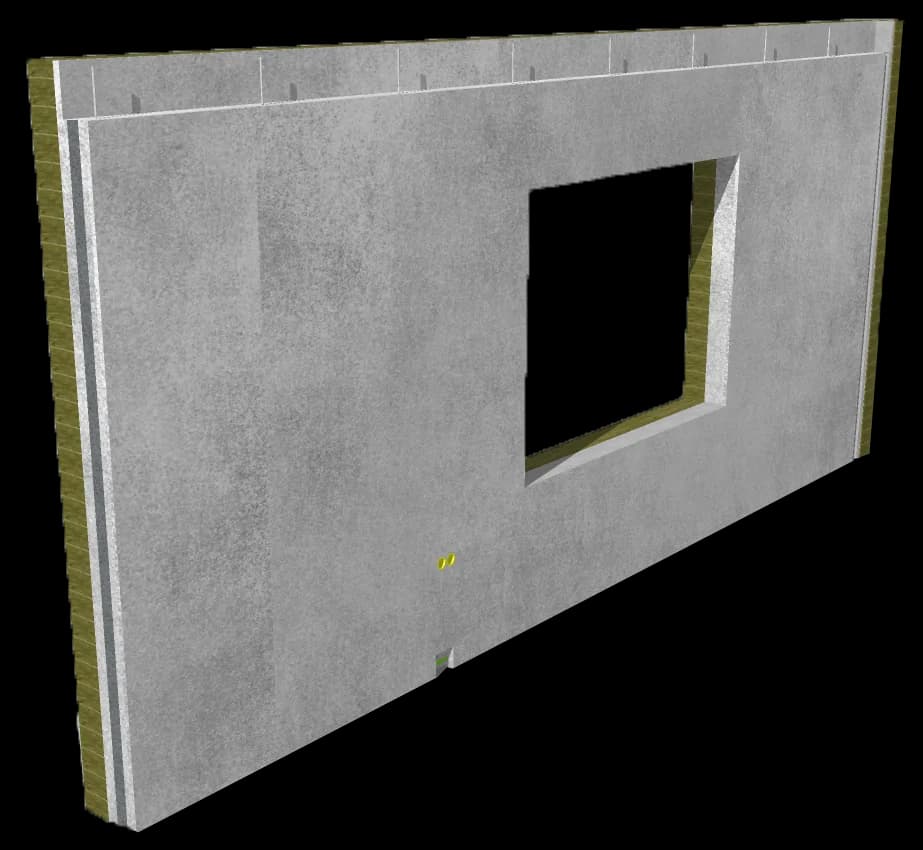
A half-sandwich wall consists of a 150 mm structural concrete leaf and an insulation layer up to 300 mm thick. As standard we use EPS, which resists rain and moisture, but versions with mineral wool, XPS and PIR are also available.
The outer layer is completed on the building site. This is the solution for projects with an individually designed facade — in brick, panel cladding or render. Before rendering, we recommend adding a layer of mineral wool over the EPS, which improves the quality of the rendered finish.
Every wall is designed for the specific building, in individual heights and lengths. On request we supply elements with cast-in electrical boxes and conduits and ready-made door and window openings.
It is sometimes called a half-sandwich wall or simply a two-layer wall; in designs it also appears as an insulated layered wall.
Two-layer wall parameters
Elements are produced in accordance with EN 14992:2007+A1:2012, under assessment system 2+ and certificate 0761-CPR-1152 issued by IBMB MPA TU Braunschweig.
EN 14992:2007+A1:2012 · Assessment system 2+ · Certificate 0761-CPR-1152 · IBMB MPA TU Braunschweig
- Maximum element dimensions
- 3,85 × 9,00 m
- Structural leaf
- 150 mm
- Element thicknesses
- 10, 12, 15, 18, 20 and 24 cm
- Insulation thickness
- Up to 300 mm
- Insulation materials
- EPS, XPS, PIR, mineral wool
- Concrete class
- LC12/13 D1,4 or higher; C20/25 or higher
- Fire resistance
- R60–R240, EI30–EI60
- Sound insulation Rw
- Up to 50 dB
- The U-value depends on the concrete class and on the type and thickness of insulation — from 0,185 W/(m²·K) with 18 cm of mineral wool to 0,117 W/(m²·K) with 18 cm of resol foam.
- Smooth surface on the mould side (DF), the other side mechanically smoothed (GF).
- Before rendering, we recommend adding a layer of mineral wool over the EPS insulation.
- The structural leaf is made of normal-weight or expanded clay (LECA) concrete; the differences in thermal conductivity and weight are compared on our expanded clay concrete page.
Thermal transmittance (U-value)
U-values for layered walls by concrete class and by insulation type and thickness. All variants meet the Polish WT 2021 requirement for external walls, i.e. a U-value no higher than 0,20 W/(m²·K).
| Concrete class | Insulation | Thickness [cm] | U [W/(m²·K)] |
|---|---|---|---|
| LC16/18 | Mineral wool / EPS (λ 0,035) | 18 | 0,182 |
| LC16/18 | Mineral wool / EPS (λ 0,035) | 20 | 0,165 |
| LC16/18 | Mineral wool / EPS (λ 0,035) | 22 | 0,151 |
| LC16/18 | Graphite EPS (λ 0,032) | 18 | 0,168 |
| LC16/18 | Graphite EPS (λ 0,032) | 20 | 0,152 |
| LC16/18 | Graphite EPS (λ 0,032) | 22 | 0,139 |
| LC16/18 | PIR (λ 0,023) | 16 | 0,137 |
| LC16/18 | PIR (λ 0,023) | 18 | 0,122 |
| LC16/18 | Resol foam (λ 0,022) | 16 | 0,131 |
| LC16/18 | Resol foam (λ 0,022) | 18 | 0,117 |
| LC20/22 | Mineral wool / EPS (λ 0,035) | 20 | 0,166 |
| LC20/22 | Resol foam (λ 0,022) | 18 | 0,118 |
| C20/25 | Mineral wool / EPS (λ 0,035) | 20 | 0,168 |
| C20/25 | Resol foam (λ 0,022) | 18 | 0,119 |
Solid, two-layer or sandwich?
Three build-ups of the same wall. They differ in how many layers are made in the factory and how many have to be completed on site.
Where the half-sandwich performs best
The solution for buildings where the facade is built on site but the insulation should arrive ready-fitted.
Brick facades
A facing leaf laid on site, over insulation that arrives finished and tightly bonded from the factory.
Rendered facades
The standard build-up of EPS topped with mineral wool beneath the render coat.
Multi-family housing
Repeatable elements in individual heights and lengths, designed for the specific building.
Energy-efficient buildings
With PIR or resol foam insulation the U-value drops to 0,117 W/(m²·K), well below the WT 2021 requirements.
What determines the price of precast elements
Precast elements are not priced from a per-metre price list — every element is designed for a specific project, and the difference between two projects of the same floor area can reach several tens of percent. So instead of a rate, we explain what actually determines the figure in your offer.
We prepare a quote within about a week of receiving complete documentation: dimensioned floor plans, sections, elevations and the site location with a postcode. The offer covers production, transport and installation — each item is priced separately, so you can see where there is room for savings.
- Element repeatability
- The single biggest variable. The same element produced in a series is markedly cheaper than a one-off, because the mould and production set-up are spread across many casts. A design based on a few repeatable types works out cheaper than one with dozens of unique elements.
- Concrete class and reinforcement
- A higher class means more cement; higher loads mean more steel. Sizing for the actual loads, rather than with excess margin, can cut the cost without compromising the structure.
- Surface finish
- A smooth, as-cast surface from the mould is standard. Form-liner textures, acid etching or architectural concrete in category BA2 or BA3 require additional formwork and tighter controls, which shows in the price.
- Factory-fitted features
- Cast-in boxes, conduits, openings and corbels increase the element price but remove the cost of chasing and fixing on site. On larger series this usually works out cheaper than doing the work on site.
- Transport and size
- The price depends on the distance and the number of loads. Elements up to 3,85 × 9,00 m travel on a standard vehicle; larger ones require abnormal-load transport with an escort vehicle and permits, which changes the calculation significantly.
- Timing and season
- Production runs in parallel with the groundworks, so ordering early gives flexibility in the programme. Forced deadlines and next-day deliveries always cost more.
We'll select the right elements for your project
Send us dimensioned floor plans, sections and elevations — we will prepare an element selection, a schedule and a quote. Preparing a quote takes around a week on average.